A flat white coffee isn’t just a small latte. They’re very different drinks. If you get caught in a cafe that doesn’t serve a flat white, then a small latte might be a passable substitute, but they’re still not the same drink. The flat white vs latte debate is common in the UK and USA where the flat white is still new.
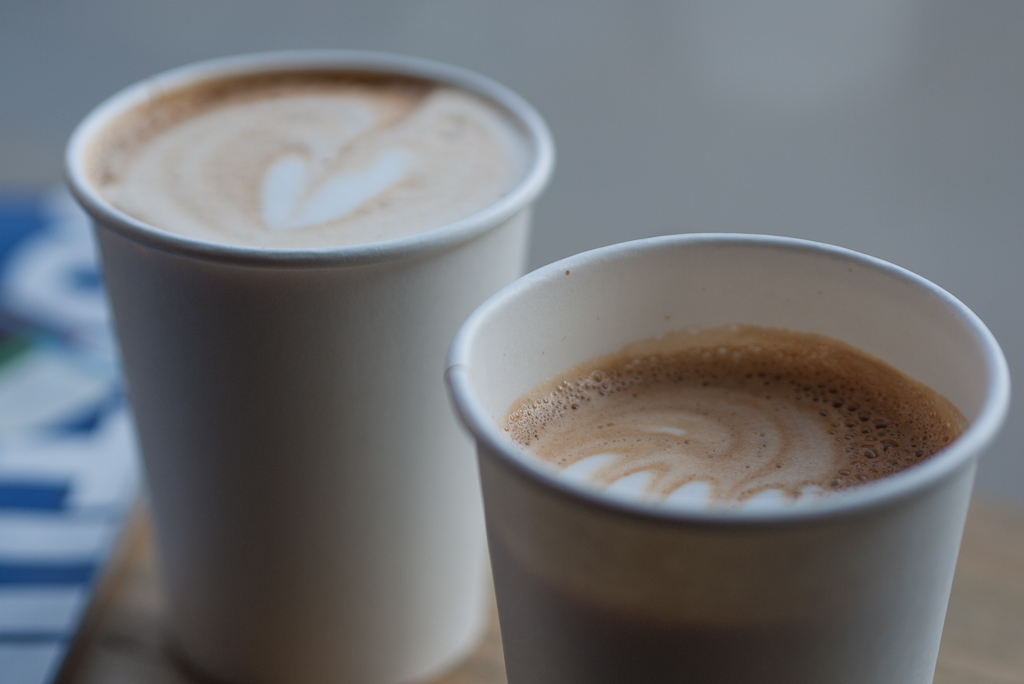
I drink flat whites and my partner drinks lattes so we’ve seen the differences between the two drinks across cafes in the UK, USA, New Zealand, Australia, France, Germany, Spain, Sweden and Denmark. I’ve had a lot of discussions with baristas and I thought it was time to shine some light on the common debate about exactly “what is a flat white?”
How can a a flat white, small latte and a small cappuccino all use the same espresso of coffee and be served in the same cup but still be different drinks?
Espresso shot: How much coffee is there in your coffee?
We can hold the preparation of the espresso as a constant across drinks. You can have a double shot or a single shot in a flat white or in a latte. Some people would say that a single shot flat white isn’t really a flat white, but that’s a bit too purist and there are plenty of cafes in New Zealand and Australia that do serve singles. Likewise, some high-end baristas will make the espresso shot differently for the different drinks (such as a ristretto shot for a Flat White). But on average, the coffee is not really what makes a Flat White different to a latte or cappuccino.
Cup: It’s not the size of the cup, it’s what you do with it
In most cafes, a flat white is smaller than a latte. But that still doesn’t mean that a flat white is just a small latte. It’s a bit like saying that a garden shed is just a smaller house. Sure, most sheds are smaller than most houses, but size isn’t the decisive factor. If a barista has been un-trained (or over-trained) then they may think that size is the only difference between a flat white and a latte. I like asking those baristas what the difference is between a cappuccino vs a latte because they have to fall back on the real differences (beyond just size).
Milk: The forgotten ingredient
If we hold the espresso as a constant, then what makes a flat white different to a latte is the way the milk is prepared and poured. Milk is the hidden ingredient in a modern coffee. Most people forget how important good milk is to a good coffee. When milk is frothed with a steam wand there are three layers that form:
- Heated liquid milk at the bottom of the pitcher
- Velvet microfoam in the middle of the pitcher (these are very small bubbles)
- Stiff froth (these are larger bubbles)
The important process of “stretching” the milk by frothing, folding and swirling it is done to maximise the amount of velvet microfoam by blending the large bubbles and the liquid milk. Without swirling and tapping there would still have some microfoam, but you’d never know it in the cup because it would be lost in the liquid and/or the froth.
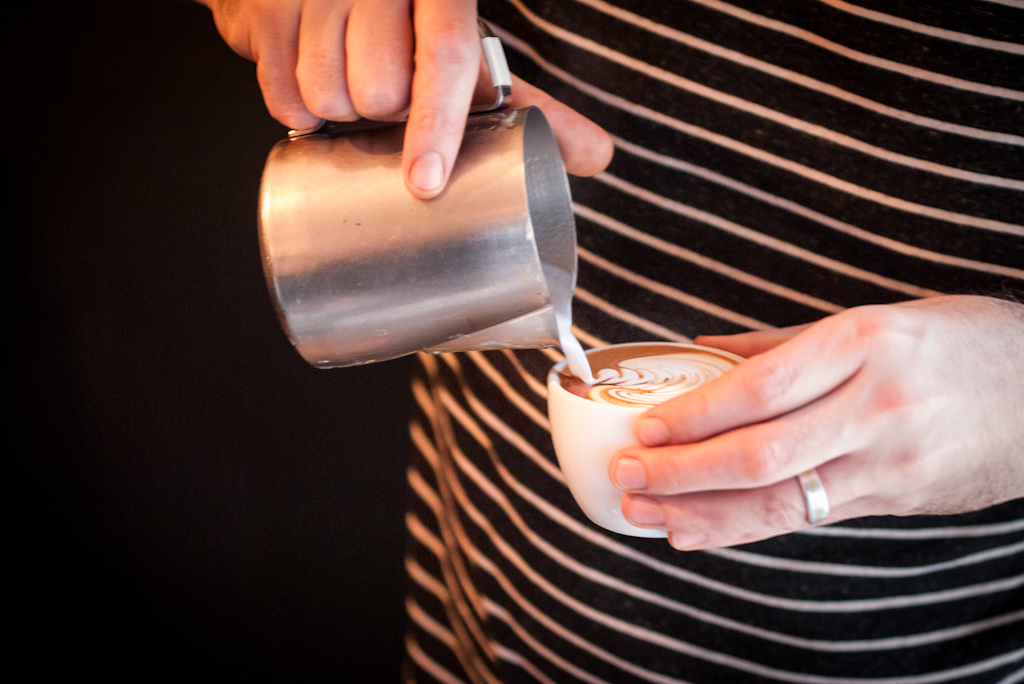
According to the Blue Bottle book Craft of Coffee, the secret to frothing milk is keeping the steam wand just at the surface of the milk (that pleasing noise you hear in busy cafes). Good baristas learn to froth milk by noticing what works and what doesn’t.
The main differences between drinks (and between baristas) arise when the steaming is finished and it’s time to pour the drink. A good barista will swirl the steamed milk around to fold the froth back into the liquid and create a seamless pitcher of velvet microfoam. Some might tap the pitcher on the counter to pop the worst of the big bubbles on top (as part of folding the milk). But this is unnecessary if you’re swirling the milk smoothly enough.
Crema: A good test of a flat white
Crema is the orange caramelised coffee that floats to the top of an espresso shot. It tastes sweeter than the dark coffee part and adds mouth-feel, but it’s very vulnerable and can be destroyed by sitting too long or being drowned in milk. A cappuccino sacrifices the crema under the weight of the stiff froth and a latte usually drowns the crema with liquid milk. One of the main ways of telling if you have been served a good flat white is how much of the milk has merged seamlessly with the crema to form an even dusky orange swirl. This coloration of the milk is also the starting point of good latte art.
Summary: How to make sure your flat white is not just a latte
An excellent barista can “free pour” straight from the pitcher using the speed of the pour and the tilt of the jug to choose how much froth, foam or liquid milk to pour into any given drink. A mid-level barista is more likely to do it like this:
- Flat white: Free pour for a velvet microfoam mix of froth and liquid.
- Cappuccino: Spoon the stiff froth into the cup and then top up with a pour from the jug.
- Latte: Pour the liquid milk from the jug with a spoon to hold back the froth and then top off with a dollop of froth.
Like any human endeavour, there is a bell curve to the skills of baristas. The most ignorant of baristas will make a flat white, latte or a cappuccino all the same. After all, they’re just a “milky coffee”. Ironically, some very high end baristas have the same attitude because they take so much care with frothing, folding and pouring their milk that every coffee is made like a perfect flat white with an even mix of liquid, microfoam and froth.
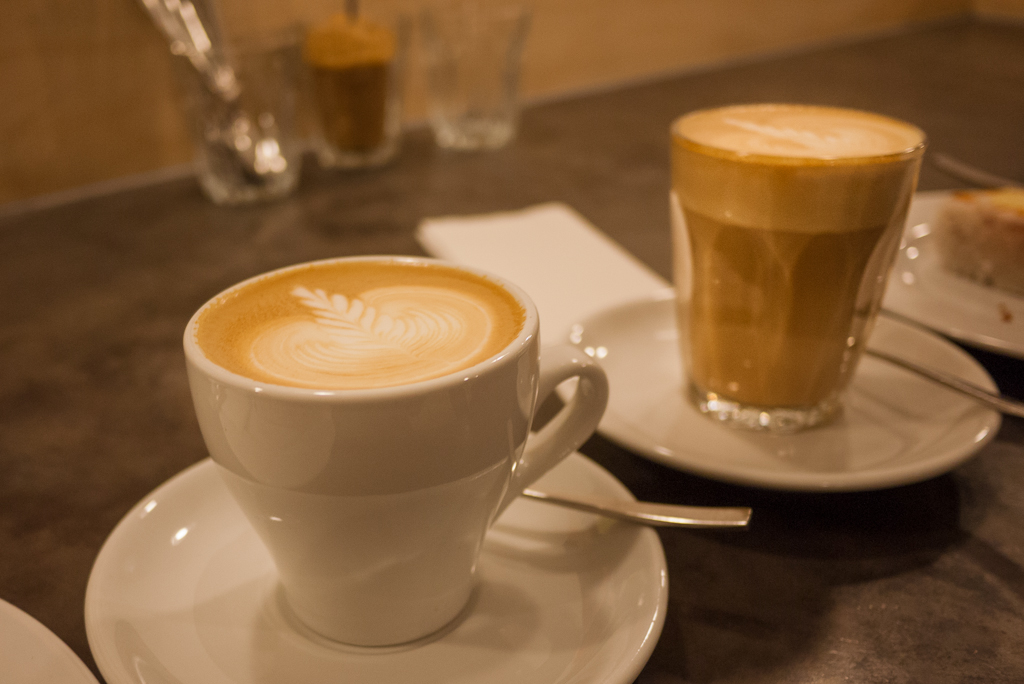
The net effect of this variety of approaches to the milk is that the drinks will feel different in the mouth and may taste different because of the dilution of the coffee with liquid. In terms of mood and mouthfeel:
- Flat White has an even mix of liquid milk and smooth velvet foam so it feels like drinking an espresso, only yummier.
- Cappuccino has stiff foam and feels like drinking bubbles with a bed of coffee hidden at the bottom.
- Latte is milky, has a little foam on the top and feels like drinking a milky coffee.
The best way to really test out the difference between a flat white and a latte is to be to go to a few small independent cafes and order both a flat white and a latte.
The goal when ordering a coffee isn’t really to express a fixed reality, it’s to try and express your tastes and preferences to the barista. Forget worrying about the technical name of your drink and just order based on a general idea what you think you’d enjoy the most: a frothy treat (cappuccino), a milky warm sensation (latte), or a short, sharp, shot that goes down easy (flat white).
Great article. I re-tweeted it. My website contains a travel story that features a description of coffee in NZ. Cheers
I haven’t seen ‘stiff froth’ on cappuccinos since the 90s
Come to Dublin and I ll make a stiff cappuccino..here it s called Dr cappuccino…
In Greece where we have gone the coffee and especially capuccinos a long way there is special milk for cafeterias to make capuccino. Also there is a different kind of milk sold only to cafeterias to make capuccino freddo (cold). This milk when whipped in an electric shaker produces a very stiff froth or foam like watery cream or watery yoghurt. We also make espresso freddo which is whipped in an electric shaker and makes a stiff crema to a cold coffee. Now you might be wondering why someone drink a cold capuccino or cold espresso. I think this has to do with the hot climate in Greece.
I was trained in the 90’a so I still make drinks pre third stage. I learned to make flat whites by asking multiple customers. After reading this article I am amazed I am dead on with making flat whites. I love making cappuccino foam that sticks to a spoon held upside down. I also love to free pour my drinks. I do not pour latte art but that is OK because I spend my time roasting our coffee to perfection.
Then you’re not at an actual coffee shop
I’m also getting sick of baristas asking me whether I want a small Flat White or a large Flat White. I might have to revise the post to note that a Flat White does kind of imply a medium size. I think it’s because in a good cafe all the drinks will be free poured with a nice even mix of velvet, froth and liquid milk. Hmmmm….
I order a large flat white (16 oz) from the coffee shop (panther coffee) in miami fl, and they seem to make it flawlessly, same goes with there large caps and lattes. There a pretty well known place and win many latte art competitions, so i guess they know what there doing, but still a large flat white is very much possible if left up to skilled baristas
It´s like asking for a 16oz espresso… There would be for sure an idiot that would order it, and a dumb enough barista that will make it…
Or else, you could perhaps make a 6 or 8 shots 16oz flat white… but for me it´s the ratio of espresso:milk that makes a flat white what it is.
Ofcourse there would be difference on the ratio of milk, espresso and the size of cup when the barista would asked you the size of your flat white. It’s not a damned thing as part of the barista who can make you small or large one, the thing is, is it really a flat white?
Well in Australia where im a trained barista there is a huge difference and people get mad if you do it wrong, a flst white very little froth a couple mm, a latee has about 8-15mm and a cappuccino has about 2cm of froth and they are all available in small, medium or large
So a flat white is milkier than the latter, latte is more velvety…that s how I do it..but then again ..here in Ireland is only a fashion/trend
I visited Australia for the first time and experienced the flat white there and very impressed. How you stated it is how I understood a flat white, latte and cappuccino to be. Back in the UK they are basically a shot of espresso with a dash of milk.
Amen to that Philip.
If you walk into a cafe and see a barista with a spoon fiddling around, spooning foam and holding it back walk back out if you are in search of good coffee!
I’m an Aussie barista and if you need to hold back foam with a spoon you’ve textured the milk wrong, dump it and start again.
It is astounding me all this debate about a flat white between countries….
As a visitor to Australia i so very miss a good Australian flat white!
I will never forget seeing 3 to 5 coffee houses in a row …..with one having a line up down the street and around the corner… and we would wait in line for that one.
I thought Brazilians made excellent coffee, as do the Austrians…but no one makes coffee like the Australians…. they live for their coffee.
Flat white….. North Americans have no idea…. unless they bring baristas from Australia!
Yep that’s my view as well
That’s what I’ve learnt by the costomers in AU. Nowadays, I’m working in South korea where just the Flat White became as trandy, Once I made A Flat White like Aussie Drinks, all local barista said that ‘It’s Just Coffee Milk with Bit of Velvet Froth. Definitely It is not Flat White Dude’ So I’m just following their Invisible Rules :(.
Absolutely agree
Their* and they’re *
How come I find it says they r a 5oz drink
In NZ we can buy a large flat white anywhere. I thought that coffee chains sold cappuccino, latte and flat white as standard. Travelling around the world we have been surprised at how th flat white seems to be a kiwi thing.
I want to facebook your post about the difference between flat whites and lattes but there’s no pretty blue button that makes this very easy for me to do *sighs dramatically* There are avid coffee drinkers amongst my friends who need to know!!
Good point! I’ve added share buttons (but they’re not as pretty as I’d like). Glad you liked the post.
A latte is a milky coffee…….a flat white is an experience!
Baristas are sick of being asked to make a flat white without being told how you like it. It’s not a good/bad barista thing. I’ve had several varying ideas of what a flat white is. My final thought is that people just want to ask for something difficult and different. 90 percent of flat whites I’ve made we’re based on pretension. Some were 8 oz no foam, some were 16 oz lattes disguised as flat whites. Very few Australians even know what a true flat white is. Surely if you believe there are bad baristas, then you can believe in bad customers. Perhaps you are the latter.
Thanks for sharing a barista’s eye view of the debate. So what’s a “true” flat white?
I’m going to just jump in here 4 years late cause I just came to your website looking for the answer for this question.
I used to (10 years ago) be a barista at a few very busy Italian restaurants in London where we were all trained by Gaggia on coffee. Flat whites didn’t exist back then.
Going from your description in the article, you’ve got lattes correct, your description of a flat white is a properly made traditional Italian cappuccino, and what you’re describing as a cappuccino is a burnt cappuccino. If you steam the milk to the point where you have stiff foam it’s because you’ve denatured the protein which will give a bitter taste and won’t mix with the coffee.
I think this all comes about because of 90s “Cappuccinos” that look like a Mr Whippy ice cream.
Baristas are sick of being asked to make a flat white without being told how you like it. It’s not a good/bad barista thing. I’ve had several varying ideas of what a flat white is. My final thought is that people just want to ask for something difficult and different. 90 percent of flat whites I’ve made we’re based on pretension. Some were 8 oz no foam, some were 16 oz lattes disguised as flat whites. Very few Australians even know what a true flat white is. Surely if you believe there are bad baristas, then you can believe in bad customers. Perhaps you are the latter.
Thanks for sharing a barista’s eye view of the debate. So what’s a “true” flat white?
I’m a barista in Australia. Before this, I grew up in GB, used to enjoy lattes and then started ordering the Starbucks flat whites when they came around. I preferred the ratio of coffee to milk but I remember no difference in texture.
So a flat white over here, where it originated is different to UK, so I have been taught. It IS about the texture. Zarraffa’s coffee (an African themed chain, cafe area itself is much like Starbucks) taught me to not add texture into the milk, holding a perfect crema above the milk. Most coffee shops will free pour and still maintain this but a spatula/spoon can be used to hold back ALL texture. However, independent cafes will still get it wrong and add texture and it often verges on a latte.
I must say I did find it interesting how different a flat white is in UK where I always thought it was more coffee-rich, to where it originated from in Australia.
I personally prefer flat whites in UK.
But that’s bevause I like stronger lattes in a small cup with silky smooth texture. I just order a latte here in Aus.
The flat white actually originated in New Zealand, just like Lorde, Russell Crowe, Crowded House and the Pavlova! If you want to taste a real flat white, NZ is where you will find it.
* one third of Crowded House 🙂
Don’t forget the Hobbit.
It is claimed by Australians that the flat white was first served in Sydney, Australia in the 1980s at Moors Espresso bar.
Absolutely
Ah. The classic debate and always stealing our stuff. At least in NZ you can go anywhere and expect great coffee. We rock those beans!!!!! I’m in the process of discovering great coffee in Ireland.
I think that the “flat” in flat white refers to no bubbles, as in the the milk is not frothy or velvety at all. I absolutely restrict all the bubbly stuff. It is nothing more than hot milk. After the pour, the coffee is a single, homogeneous colour. The clue is in the very name of the drink. A lot of new wave baristi who have been trained in a lot of the modern trendy chains to make velvet foam every time. And yes, I am Australian and have been a barista.
I am also a highly experienced barista living in Australia my whole life. Grown up with flat whites my whole life. When I was introduced to Starbucks and American flat whites it was not even close to what I knew. Just an American latte with a different name. Flat whites have always been just a layer of micro foam but not enough to break the crema. As one of my employers once told me, just enough micro foam to do latte art. I think that was just a marketing ploy to show off barista’s especially in Melbourne which has created all this confusion. Usually what you expect to get when you order a flat white is what the name suggests. A white coffee (lot’s of milk) with no foam (flat). There’s no drip coffee in Australia so white refers to espresso with milk just like a black coffee refers to espresso with out milk. Hence the flat white. Long blacks are Americanos and short blacks are espresso’s.
Yes yes yes!!! Finally someone I agree with!
(Note that in Italian the masculine plural goes from -o- to -i- so macchiato to machiatti. The feminine plural goes from -a- to -e- so barista to bariste.)
Lol. I agree
Just got my first coffee machine, but looking for some nice flat white coffee cups alittle bit different to the normal cups
Bodum do some interesting double walled glass coffee cups.
A flatwhite is a small, strong, milky coffee. As far as I’m concerned, as a barista, the best way is 2 shots, silky milk and total drink no bigger than 7oz.
A flatwhite is a small, strong, milky coffee. As far as I’m concerned, as a barista, the best way is 2 shots, silky milk and total drink no bigger than 7oz.
That’s a Piccolo champion….
How do you get a good cup of coffee in these places? Seriously. No milk, no cream, just a nice cup of coffee from a french press, with all the essential oils and aromas, and even a smile from behind the counter. Is that just something you can’t have in a cafe that has taken steaming milk and pouring it into an advanced art form? Since the advent of Starbucks and cafes with expresso machines, you can’t even get a good cup of expresso, and certainly not a simple cup of well made coffee. I walk in, look for coffee, and walk out. Cafes should have coffee on the menu, in my opinion.
You most definitely can order a French press at any Starbucks and surely most cafés. All you have to do is put in the effort to ask the barista. And perhaps “coffee” isn’t on the menu because most places hope you realise that it’s a “coffee house” and therefore, obviously has a good regular cup of coffee waiting for you if you so choose it.
Go to Hawaii and New Zealand (south island), from my experience they have amazing black coffee.
Anywhere in NZ
Oh yeah. You sound like you know what you’re talking about Mr. Expresso. (Interesting article btw)
How do you get a good cup of coffee in these places? Seriously. No milk, no cream, just a nice cup of coffee from a french press, with all the essential oils and aromas, and even a smile from behind the counter. Is that just something you can’t have in a cafe that has taken steaming milk and pouring it into an advanced art form? Since the advent of Starbucks and cafes with expresso machines, you can’t even get a good cup of expresso, and certainly not a simple cup of well made coffee. I walk in, look for coffee, and walk out. Cafes should have coffee on the menu, in my opinion.
Espresso
+1
THANK YOU!!! Lol
You most definitely can order a French press at any Starbucks and surely most cafés. All you have to do is put in the effort to ask the barista. And perhaps “coffee” isn’t on the menu because most places hope you realise that it’s a “coffee house” and therefore, obviously has a good regular cup of coffee waiting for you if you so choose it.
Go to Hawaii and New Zealand (south island), from my experience they have amazing black coffee.
Anywhere in NZ
Oh yeah. You sound like you know what you’re talking about Mr. Expresso. (Interesting article btw)
Do you just LOOK for the coffee, or do you ask? Starbucks, for one, should ALWAYS have brewed coffee available (many with the Clover brewer, which gives you many roast options all day long), but while not “on the menu,” you should be able to ask for a French press any time. If you know a store that you think doesn’t offer this, ask the manager. Some employees aren’t aware simply because it’s not asked for often enough!
My husband, daughter and I just returned from a visit to London. We stayed in Hampstead and stopped daily at Ginger and White for our flat white fix–addictive and delicious.
My husband, daughter and I just returned from a visit to London. We stayed in Hampstead and stopped daily at Ginger and White for our flat white fix–addictive and delicious.
Flat White?! Rather unfortunate (and even depressing) name for an espresso based drink that should give you a zing akin to seeing that red Ferrari parked outside the “Third Noise Cafe”. Coffee is starting to turn into the abomination that Starbucks is. Espresso should not be like liquefied licorice and that pathetic luke-warm liquid under the foam of a Cappuccio should not remind one as somebody on this forum said of “Cambells Tomato Soup” or chicory or even worse it should not leave you wondering if that’s what urine tastes like. Un caffe per piacere. Ristretto? Lungo? Macchiato?Lungo macchiato? Doppio? Doppio macchiato? Cappuccio? Cappuccio doppio? Cappuccio doppio senza schuima? Caffe corretto? Latte macchiato? Nocciolato?Granita di Caffe. Affogato? Anyone?
I rather think affogato is much more depressing name…. It means drowned!
⬆ Good one Chelle!
Ristretto- less water through the shot, about half but with the same amount of grinds.
Lungo- long shot with more water, same amount of grinds.
Macchiato- to mark/marked, traditional macchiato consists of espresso “marked” with a dollop of foam.
Lungo Macchiato- long shot macchiato
Doppio- double
Doppio Macchiato- two espresso shots w/ a dollop of foam
Affogoto- gelato (or icecream) with espresso over the top
Latte Macchiato- Latte with shots poured on top of the foam, instead of mixed in with the poured milk?
“senza schuima? Caffe corretto?…Nocciolato?Granita di Caffe” Those escaped me. However, not bad for an “abominable” Starbucks barista, no? It’s all about how much the barista cares, not about the company.
By the way, I really liked this article. I’ve had maybe two people request flat whites and couldn’t figure out how they were different than a latte (though one person swore it was a completely no foam latte). This makes more sense, and since I’ve been practicing my latte art, it’s what I’ve been doing which is really helpful to know.
*schiuma – foam, senza schiuma – foamless.
Caffè corretto – espresso with booze, eg grappa or sambucca, depending on region.
Nocciolato – it’s a Campagna thing, Coffee with cocoa and hazelnut flavouring (the same stuff used to make nutella).
Granita – a flavoured ice drink, and in this case made with coffee, and usually topped with cream and sweetened.
Macchiato means stained. English has the cognate immaculate, as in the immaculate conception, as in not ‘stained’ with original sin. Fascinating stuff?
And, yeah, latte’ macchiato is milk ‘stained’ with coffee.
In bell’Italia, sometimes hear the phrase “latte’ caffe'” to mean a very milky coffee or rather milk that has coffee added rather than the other way around.
And I am sure you’ve heard at least one of the stories behind the cappuccino. It’s named for the Capuchin friars, and depending on the story its might be because it was invented by a capuchin, or because it looks like a capuchin (they wear brown, hooded cloaks, and are tonsured).
Really?! My understanding was that macchiato translates to ‘marked’ and was espresso marked with milk rather than the reverse?!?!!
Flat White?! Rather unfortunate (and even depressing) name for an espresso based drink that should give you a zing akin to seeing that red Ferrari parked outside the “Third Noise Cafe”. Coffee is starting to turn into the abomination that Starbucks is. Espresso should not be like liquefied licorice and that pathetic luke-warm liquid under the foam of a Cappuccio should not remind one as somebody on this forum said of “Cambells Tomato Soup” or chicory or even worse it should not leave you wondering if that’s what urine tastes like. Un caffe per piacere. Ristretto? Lungo? Macchiato?Lungo macchiato? Doppio? Doppio macchiato? Cappuccio? Cappuccio doppio? Cappuccio doppio senza schuima? Caffe corretto? Latte macchiato? Nocciolato?Granita di Caffe. Affogato? Anyone?
I rather think affogato is much more depressing name…. It means drowned!
⬆ Good one Chelle!
Ristretto- less water through the shot, about half but with the same amount of grinds.
Lungo- long shot with more water, same amount of grinds.
Macchiato- to mark/marked, traditional macchiato consists of espresso “marked” with a dollop of foam.
Lungo Macchiato- long shot macchiato
Doppio- double
Doppio Macchiato- two espresso shots w/ a dollop of foam
Affogoto- gelato (or icecream) with espresso over the top
Latte Macchiato- Latte with shots poured on top of the foam, instead of mixed in with the poured milk?
“senza schuima? Caffe corretto?…Nocciolato?Granita di Caffe” Those escaped me. However, not bad for an “abominable” Starbucks barista, no? It’s all about how much the barista cares, not about the company.
By the way, I really liked this article. I’ve had maybe two people request flat whites and couldn’t figure out how they were different than a latte (though one person swore it was a completely no foam latte). This makes more sense, and since I’ve been practicing my latte art, it’s what I’ve been doing which is really helpful to know.
*schiuma – foam, senza schiuma – foamless.
Caffè corretto – espresso with booze, eg grappa or sambucca, depending on region.
Nocciolato – it’s a Campagna thing, Coffee with cocoa and hazelnut flavouring (the same stuff used to make nutella).
Granita – a flavoured ice drink, and in this case made with coffee, and usually topped with cream and sweetened.
Macchiato means stained. English has the cognate immaculate, as in the immaculate conception, as in not ‘stained’ with original sin. Fascinating stuff?
And, yeah, latte’ macchiato is milk ‘stained’ with coffee.
In bell’Italia, sometimes hear the phrase “latte’ caffe'” to mean a very milky coffee or rather milk that has coffee added rather than the other way around.
And I am sure you’ve heard at least one of the stories behind the cappuccino. It’s named for the Capuchin friars, and depending on the story its might be because it was invented by a capuchin, or because it looks like a capuchin (they wear brown, hooded cloaks, and are tonsured).
Really?! My understanding was that macchiato translates to ‘marked’ and was espresso marked with milk rather than the reverse?!?!!
We have returned to the ‘Flat White’ Issue again up here in Scotland.
I have read and re-read through your posts concerning the subject, and posted on one a while ago, but more time has passed and we and the industry have matured.
I totally agree with your description of a Flat White as laid down. Ours in our coffee bar is:
– 6oz glass cup, tulip
– double espresso of any blend or SO
– topped up to 6oz with correctly stretched milk like you would use for a latte.
My bone of contention with the industry just now (especially Costa etc) is that they seem to be promoting that Cappucini and Latte are lesser drinks because the milk is of a lesser quality.
I think we should move towards all baristi being at a good enough skill level to produce all the variations of milk based coffee according to their ratio levels rather than lack of quality?
Your flat white sounds yum!
We have returned to the ‘Flat White’ Issue again up here in Scotland.
I have read and re-read through your posts concerning the subject, and posted on one a while ago, but more time has passed and we and the industry have matured.
I totally agree with your description of a Flat White as laid down. Ours in our coffee bar is:
– 6oz glass cup, tulip
– double espresso of any blend or SO
– topped up to 6oz with correctly stretched milk like you would use for a latte.
My bone of contention with the industry just now (especially Costa etc) is that they seem to be promoting that Cappucini and Latte are lesser drinks because the milk is of a lesser quality.
I think we should move towards all baristi being at a good enough skill level to produce all the variations of milk based coffee according to their ratio levels rather than lack of quality?
Your flat white sounds yum!
Annoyingly for me, my first ever Flat White was in a Costa Coffee — what’s more annoying is that it’s been the best one that I’ve had to date. I’ve tried a handful of times since then to get what I thought was going to be a Flat White, but instead I just get a big pile of froth over a milky coffee.
I’ll mainly order an Espresso, Macchiato or Americano and shy away from other options as I don’t like the milk to take over the taste and texture. The thing I like about a Flat White is point 4. in your ‘What is a Flat White’ post — “free poured milk so that the foam is folded through the whole drink and there is no discernable layer separation between liquid coffee and foam”.
People may say I’m drinking in the wrong places (Cardiff not London), and perhaps I am, but if only there was a standard so you knew what you were going to get. I’m going to be a bit more inquisitive next time I order, and check that the barista and I are on the same page before any milk gets poured, hopes get crushed and tears start to fall.
Samuel,
If you’re still in Cardiff, try The Plan Cafe (in the Morgan Arcade), Torre Cafe (outside the castle) and Waterloo Tea (three branches now). All of them should be able to make you a flat white that’ll knock the socks off a Costa Coffee flat white (for what it’s worth, I’ve never had a good flat white at Costa, but then I’ve only tried maybe two or three before giving up in disgust; as far as I’m concerned, a Costa flat white is way too big).
Brian.
Samuel, I like Costa flat whites as well. You can order them in an independent coffee shop but they are very variable .
We visit Northern Ireland frequently and our local restaurant, Harry’s Shack, can’t produce a good espresso to save their lives but their flat whites are exquisite.
Lavazza at Belfast city airport produces a cappuccino that is near to a flat white. Starbucks in the UK are best avoided all round.
Peter,
Just a quick note to say “thank you.” I read reviews/articles like this all the time and typically end up searching for more info because the first few posts I read are lacking substance. Then on the rare occasion, I read a piece like this one and just simply appreciate how well some people write. I really liked your description of Flay White – articulate, informative and concise. Thanks again!
Peter,
Just a quick note to say “thank you.” I read reviews/articles like this all the time and typically end up searching for more info because the first few posts I read are lacking substance. Then on the rare occasion, I read a piece like this one and just simply appreciate how well some people write. I really liked your description of Flay White – articulate, informative and concise. Thanks again!
Excellent description. I have family visiting from overseas and I had never heard of a flat white. As it turns out I have been making them at home and calling it a latte. I guess I didn’t know how lattes we’re supposed to be made. :O
Excellent description. I have family visiting from overseas and I had never heard of a flat white. As it turns out I have been making them at home and calling it a latte. I guess I didn’t know how lattes we’re supposed to be made. :O
I agree that a flat white should only be served in 7oz and when offered which size I know I’m in the wrong place
I’d question how a single shot fw can hit the mark.
Ok so after 20 years of drinking and making, it does not change:
6-8oz double shot ristretto, slightly cooler micro foam textured milk, free pour so the milk and double espresso combine to a silky consistency. Preference even cover between crema and milk, (flat and white). No pretention, but done properly in the hand of an experienced barista, taste of heaven.
THANK YOU! …pretty sure the ristretto shot is just as vital as the rest of it…..
Ok so after 20 years of drinking and making, it does not change:
6-8oz double shot ristretto, slightly cooler micro foam textured milk, free pour so the milk and double espresso combine to a silky consistency. Preference even cover between crema and milk, (flat and white). No pretention, but done properly in the hand of an experienced barista, taste of heaven.
THANK YOU! …pretty sure the ristretto shot is just as vital as the rest of it…..
I read the article and still have absolutely no idea what the difference is between a flat white and latte.
From the article, a latte has milk and froth, but a flat white has froth and milk.
Baffling.
microfoam. It’s the creamy mouthfeel that the microfoam gives, and if combined with ristretto as opposed to espresso, tends to be ‘sweeter’ and more delicate overall. It’s like the polar opposite of the burnt, over roasted, double long, bitter ‘espresso’ you might get that reduces coffee to a caffeine delivery system instead of the delicious, complex, beverage it can be.
I read the article and still have absolutely no idea what the difference is between a flat white and latte.
From the article, a latte has milk and froth, but a flat white has froth and milk.
Baffling.
microfoam. It’s the creamy mouthfeel that the microfoam gives, and if combined with ristretto as opposed to espresso, tends to be ‘sweeter’ and more delicate overall. It’s like the polar opposite of the burnt, over roasted, double long, bitter ‘espresso’ you might get that reduces coffee to a caffeine delivery system instead of the delicious, complex, beverage it can be.
As a barista, there are a few more differences between a flat white and a latte that you’ve missed out.
Flat whites should be served at a lower temperature than lattes, around 54°C. Whole milk is normally used as standard as it froths significantly better, and gives it more of a velvety feel to it, though you can of course request other milks.
The main difference between a flat white and a latte is the proportion of espresso to milk, the place I work at serves it in a 6oz cup, which really gives it a stronger feel.
The most irritating thing is when customers attempt to order a “large flat white” as it simply doesn’t exist, yet they refuse to listen and claim that they “order it at Costa all the time”
*sighs*
What? A barista that thinks a “large flat white” doesn’t exist? That’s crazy talk. Flat whites can absolutely be scaled up. A large flat should simply increase the amount of coffee to sustain that nice kick of a flat white. With the same microfoam character as a regular flat, you just need a basket that can fit more than 21 grams. Really pack it in, and make me a large flat white, no sugar thanks.
what? no such thing as large flat white? if a regular flat white is a double shot of espresso in a slightly smaller cup, then fill rest with microfoam. Then a large Flat white is a quadrouple shot, in a large cup and fill rest with microfoam.
As a barista, there are a few more differences between a flat white and a latte that you’ve missed out.
Flat whites should be served at a lower temperature than lattes, around 54°C. Whole milk is normally used as standard as it froths significantly better, and gives it more of a velvety feel to it, though you can of course request other milks.
The main difference between a flat white and a latte is the proportion of espresso to milk, the place I work at serves it in a 6oz cup, which really gives it a stronger feel.
The most irritating thing is when customers attempt to order a “large flat white” as it simply doesn’t exist, yet they refuse to listen and claim that they “order it at Costa all the time”
*sighs*
What? A barista that thinks a “large flat white” doesn’t exist? That’s crazy talk. Flat whites can absolutely be scaled up. A large flat should simply increase the amount of coffee to sustain that nice kick of a flat white. With the same microfoam character as a regular flat, you just need a basket that can fit more than 21 grams. Really pack it in, and make me a large flat white, no sugar thanks.
what? no such thing as large flat white? if a regular flat white is a double shot of espresso in a slightly smaller cup, then fill rest with microfoam. Then a large Flat white is a quadrouple shot, in a large cup and fill rest with microfoam.
Thank you for the article.
I’m not much of a coffee drinker, when I went to New Zealand and had a flat white in Raglan I was hooked had 2 or 3 a day like 2 dollars each. Came back to US and looked for a flat white. Asking for it hopeing that they would know what I was talking about. Then they say oh, you mean a 4.50 latte, I had a latte, and it’s just not the Same.
Here in the US, the best flat white I’ve had is at Perq’s in Sarasota (not a chain), they really know what they’re doing, a real pleasure.
Thank you for the article.
I’m not much of a coffee drinker, when I went to New Zealand and had a flat white in Raglan I was hooked had 2 or 3 a day like 2 dollars each. Came back to US and looked for a flat white. Asking for it hopeing that they would know what I was talking about. Then they say oh, you mean a 4.50 latte, I had a latte, and it’s just not the Same.
Here in the US, the best flat white I’ve had is at Perq’s in Sarasota (not a chain), they really know what they’re doing, a real pleasure.
Flat White is my drink. I like it and I know in most cases I’m going to get a strong coffee but with milk which is why I always go for it.
Last week I sent an email to Costa complaining about the quality of my last 5 Flat Whites. My disappointment has led me to wanting to now create them at home and not rely on my local Costa (there’s no fantastic independents where I live) but the one question I’m struggling to get an answer to is the cup size…6 oz or 8 oz? Origin Coffee on Vimeo says no bigger than 8 and that’s what I use at home but whilst looking for a new mug I found this http://www.coffeehit.co.uk/cafe-supplies/coffee-cups/blue-flat-white-cup-saucer-160ml-6oz which suggests I should be using a 6 oz cup for Flat Whites?
Would 6 oz with a double shot create a perfect flat white or should I stick with 8 oz?
Flat White is my drink. I like it and I know in most cases I’m going to get a strong coffee but with milk which is why I always go for it.
Last week I sent an email to Costa complaining about the quality of my last 5 Flat Whites. My disappointment has led me to wanting to now create them at home and not rely on my local Costa (there’s no fantastic independents where I live) but the one question I’m struggling to get an answer to is the cup size…6 oz or 8 oz? Origin Coffee on Vimeo says no bigger than 8 and that’s what I use at home but whilst looking for a new mug I found this http://www.coffeehit.co.uk/cafe-supplies/coffee-cups/blue-flat-white-cup-saucer-160ml-6oz which suggests I should be using a 6 oz cup for Flat Whites?
Would 6 oz with a double shot create a perfect flat white or should I stick with 8 oz?
The take away I’m getting here is that a flat white is an improved and better thought through version of a latte.
Depends on your preference. Old school, homemade, latte is a very milky drink made on a stove top – think of the opening scenes of La Terra Trema.
Latte as served in cafes seems to be this homemade stuff commercialised and “cheffed-up” into a more respectable beverage. In some respects it feels compromised and almost unitalian.
The flat white seems to be commercial from the ground up, rooted firmly in the espresso machine and steamed milk. All very Milano and raffinato.
The take away I’m getting here is that a flat white is an improved and better thought through version of a latte.
Depends on your preference. Old school, homemade, latte is a very milky drink made on a stove top – think of the opening scenes of La Terra Trema.
Latte as served in cafes seems to be this homemade stuff commercialised and “cheffed-up” into a more respectable beverage. In some respects it feels compromised and almost unitalian.
The flat white seems to be commercial from the ground up, rooted firmly in the espresso machine and steamed milk. All very Milano and raffinato.
Actually a flat white in New Zealand has humble beginings. Its interesting hearing all the comments some of which hit the mark others which are a product of an evolving industry and a corporate industry scrambling to emmulate the ingenuity of small independent roastary and cafe networks.
In the 70’s a Flat White in Aotearoa was just a nice punchy Americano with some milk. It evolved with latte art and was probably close to what it is now by the end of the nineties in certain select places in New Zealand. So what you are now getting worldwide now was happening 20 years ago in New Zealand and Austraila and much of it is being copied from a much lower standard or poorer starting point. Great beans with good roast profiles and running shots and stretching milk to perfection all have to be nailed otherwise no matter what the ratio’s of milk /espresso often the resulting coffee is sad.
That said there are amazing coffee’s to be had and the real skill is finding it and latching on to it. In East london there’s so much good coffee as opposed to west london and usually its Kiwi’s and Aussies behind the wheel. Typically I do not order from a place that does not chase the grind or surf the grind as is known down under. Much of the flavour of extraction is controlled by the grind which changes throughout the day. I dont care if they know all their ratios and maths and even weigh the shots……If they dont have a good feel for the profile of the shots and cant get the milk right its all over. The stretching of milk is different for different coffees both in process and in managing it. One of my Barristas used to rap to the music that he was THE MICROFOAM CONTROLLER……and really it was true after I’d line up some dope shots. Great thing about coffee is that there is always something more to learn. The bad thing is once you’ve had good coffee consistently its hard to drink a cup of rough joe.
I didn’t realise how pretentious the world had become until I read this article.
I didn’t realise how pretentious the world had become until I read this article.
Great article. I’m still kinda confused though haha. Last time I ordered a flat white I asked the barista what it was. He said that it’s kind of like a cappuccino but more creamy. I guess his right, right ;)? Anyway. It was a great flat white.
Great article. I’m still kinda confused though haha. Last time I ordered a flat white I asked the barista what it was. He said that it’s kind of like a cappuccino but more creamy. I guess his right, right ;)? Anyway. It was a great flat white.
Very good, informative article. You explain the good and bad techniques of making coffee. However, I’m not sure you answer the question of ‘what is the difference between a latte and flat white’.
For me, one point that has been touched on but not explicitly said is that an important part is the ratio of espresso to milk. For me a flat white has a much lower ratio of milk to espresso. Personally I like a ratio of 2:1 or 3:1 for a flat white and 5:1 upwards for a latte. For this reason, I think it is technically possible to have a one shot flat white (serve in a 3oz cup) or to have a flat white in a 16oz cup (5 or 6 shots of espresso would be a bit much for me though) so long as the ratio is kept.
Obviously all the other aspects mentioned above such as temperature and texture of the milk go with out saying.
Go to any reputable coffee shop and no one is spooning foam on anything, Everything is poured freehand, so a flat white, cortado, cappuccino, and latte all end up being very similar. Only the size is the determining factor.
Thank you! I’m not alone! It’s sounds to me like people are just now discovering the wonders of a correctly made espresso drink, mistakingly thinking it’s a new phenomenon and assuming that bad coffee making habits are the old way of doing things. This isn’t new people. This is how good espresso drinks are made. It’s just a different form factor.
Go to any reputable coffee shop and no one is spooning foam on anything, Everything is poured freehand, so a flat white, cortado, cappuccino, and latte all end up being very similar. Only the size is the determining factor.
Thank you! I’m not alone! It’s sounds to me like people are just now discovering the wonders of a correctly made espresso drink, mistakingly thinking it’s a new phenomenon and assuming that bad coffee making habits are the old way of doing things. This isn’t new people. This is how good espresso drinks are made. It’s just a different form factor.
I worked making coffee in Australia and New Zealand and the way i was told to make a flat white was, the smaller like everyone has agreed but the milk isn’t stretched as far as you would with a latte.
*the smaller size like everyone has agreed
I worked making coffee in Australia and New Zealand and the way i was told to make a flat white was, the smaller like everyone has agreed but the milk isn’t stretched as far as you would with a latte.
*the smaller size like everyone has agreed
I recently tried ordering a flat white at a hotel cafe in Bakersfield, Ca and the barista gave me an amused little look before smugly telling me it’s just what Australians call a latte. I was too irritated to explain to her the difference especially since I had the feeling even if I explained it to her she’d still just make me a latte anyways.
Same here in CT, its so frustratingly annoying! I ended up being served a giant over milky latte, because they said “that’s just a wet latte that the Australians put a fancy name on and decided to charge more money for, so her you go.” UGH!
I recently tried ordering a flat white at a hotel cafe in Bakersfield, Ca and the barista gave me an amused little look before smugly telling me it’s just what Australians call a latte. I was too irritated to explain to her the difference especially since I had the feeling even if I explained it to her she’d still just make me a latte anyways.
Same here in CT, its so frustratingly annoying! I ended up being served a giant over milky latte, because they said “that’s just a wet latte that the Australians put a fancy name on and decided to charge more money for, so her you go.” UGH!
I first experienced the flat white when I was living in New Zealand a few years back. Frankly I spent all my time trying (and failing) to find an honest cappuccino. Every barista in New Zealand seems obsessed with the quality of the milk, to the extent that the coffee comes off as an afterthought. Every flat white ends up tasting essentially the same as the coffee is never allowed to be separate from the milk. It was a step up from the near-universal instant coffee everyone keeps in a jar next to their sugar and tea, but i doubt the coffee will ever be ground breaking as long as the culture is milk-obsessed.
I first experienced the flat white when I was living in New Zealand a few years back. Frankly I spent all my time trying (and failing) to find an honest cappuccino. Every barista in New Zealand seems obsessed with the quality of the milk, to the extent that the coffee comes off as an afterthought. Every flat white ends up tasting essentially the same as the coffee is never allowed to be separate from the milk. It was a step up from the near-universal instant coffee everyone keeps in a jar next to their sugar and tea, but i doubt the coffee will ever be ground breaking as long as the culture is milk-obsessed.
It’s all just too confusing. I disagree with this article totally. It seems to imply that a flat white has smooth creamy milk and a cappuccino has ‘stiff’ foam!?! Both drinks have, if well made, smooth and silky milk. A cappuccino is just lighter textured as it’s more aerated. Provided the milk is stretched before it gets above 100f and then spun it will be shiny. For me any Milky espresso beverage should have care and attention given it. This will result in a smooth drink. Inevitably if a cappuccino sits around the foam will stiffen. But so will that of a flat white or a latte-there’s just less of it so its not as obvious. Should be a moot point however as to be enjoyed at their best they should both be consumed reasonably quickly.
I don’t think there’s a law anywhere that states a latte has more froth than a flat white and I dont think that would ever consistently be the case-ergo a carefully made flat white and a carefully made latte are the same albeit tradition seems to be one is 6oz and the other 8oz. Flat whites are spoken about as though there’s some mystical secret. Nope;) as for milk temp absolutely shouldn’t be too hot but I’d say 54c as suggested would be the low side of acceptable and 68-70c the absolute max to retain sweetness. Check out prufrocks menu-coffee w milk 4,6 or 8oz perfectly shiny, silky and smooth. Tells you what multiple wbc’s think of the whole debate;)
It’s all just too confusing. I disagree with this article totally. It seems to imply that a flat white has smooth creamy milk and a cappuccino has ‘stiff’ foam!?! Both drinks have, if well made, smooth and silky milk. A cappuccino is just lighter textured as it’s more aerated. Provided the milk is stretched before it gets above 100f and then spun it will be shiny. For me any Milky espresso beverage should have care and attention given it. This will result in a smooth drink. Inevitably if a cappuccino sits around the foam will stiffen. But so will that of a flat white or a latte-there’s just less of it so its not as obvious. Should be a moot point however as to be enjoyed at their best they should both be consumed reasonably quickly.
I don’t think there’s a law anywhere that states a latte has more froth than a flat white and I dont think that would ever consistently be the case-ergo a carefully made flat white and a carefully made latte are the same albeit tradition seems to be one is 6oz and the other 8oz. Flat whites are spoken about as though there’s some mystical secret. Nope;) as for milk temp absolutely shouldn’t be too hot but I’d say 54c as suggested would be the low side of acceptable and 68-70c the absolute max to retain sweetness. Check out prufrocks menu-coffee w milk 4,6 or 8oz perfectly shiny, silky and smooth. Tells you what multiple wbc’s think of the whole debate;)
Everyone seems to be pretty deep into flat white/latte discussion these days. I have to review Czech coffee scene and ask baristas what knowledge our customers and batistas have in the time when coffee culture is improving live in front of your eyes everyday.
I keep getting served a latté in a tall glass which is really annoying, it looks like I’m drinking a milk shake, quickly cools to the temperature of a milk shake, and is very badly balanced in the hand. I’m now a converted flat white man.
What is left unsaid is why the Flat White exists in the first place. Unlike the classic espresso drinks – latte, cappuccino, macchiato- the Flat White is a recent invention.
I’ve nothing against it, but for the most part, it’s a convenient replacement for the other milky drinks, easier for a barista to make and allows for that of-so-important “latte art” to be displayed. For the most part, the big chains -*$, Costa, Nero – can make a good coffee, but they like to make it their way, not your way. So you will often get a cappuccino that’s actually a latte (Pret and *$) or a cappuccino that’s a Flat White so they can make a pretty picture on top (not really possible with proper cappuccino foam).
No one was crying out for the Flat White. It’s really just a way to simplify the “espresso and milk” drink and allow for nice latte art to be shown off.
What is left unsaid is why the Flat White exists in the first place. Unlike the classic espresso drinks – latte, cappuccino, macchiato- the Flat White is a recent invention.
I’ve nothing against it, but for the most part, it’s a convenient replacement for the other milky drinks, easier for a barista to make and allows for that of-so-important “latte art” to be displayed. For the most part, the big chains -*$, Costa, Nero – can make a good coffee, but they like to make it their way, not your way. So you will often get a cappuccino that’s actually a latte (Pret and *$) or a cappuccino that’s a Flat White so they can make a pretty picture on top (not really possible with proper cappuccino foam).
No one was crying out for the Flat White. It’s really just a way to simplify the “espresso and milk” drink and allow for nice latte art to be shown off.
Next up should be the Long Black vs Americano debate.
Most independent cafes in London still get this wrong.
The order in which a long black is made (water first, espresso second) is important—reversing the steps will destroy the crema from the espresso shot and make an Americano.
Next up should be the Long Black vs Americano debate.
Most independent cafes in London still get this wrong.
The order in which a long black is made (water first, espresso second) is important—reversing the steps will destroy the crema from the espresso shot and make an Americano.
You write that a cappuccino has stiff, bubbly milk froth on top. I believe that is the American version, which has the same kind of froth as a Latte Macchiato. An original cappuccino should not have heated milk and separate stiff milk froth, but only a semi-fluid fluffy milk foam mixed with the espresso. If you do it this way it has a great, consistent texture, and a very brown surface (hence the name). The German Wikipedia backs this theory, while the English does not.
I like coffee, but I’m neither a barista nor an expert. Researching coffee on the web I have learned the following things:
1) most coffee “afficinados” on the web are just smug narcissists full of … used coffee ground. Particularly those who just started a career as a barista. Not meant personally and not directed at this blog; this article is written positively pragmatic and casual. I like that!
2) It doesn’t matter what anyone says anyway, because the official definitions differ from country to country (in Germany a traditional caffè latte (“Milchkaffee”) has drip coffee because we have no idea of good coffee whatsoever); and in the end even every coffee shop does whatever it wants.
I usually order a cappuccino, and I’m always wondering what I will get. Often times it has a tiny alibi portion of foam on it, while the cafè latte looks like what I wanted; once I got a coffee with whip cream on it – not kidding! By the way I’ve never seen a “Flat White” and I wouldn’t even know what it’s called in my country. Wikipedia says it’s an Australian hybrid. Okay then …
By the way, you say that the crema is caramelized coffee. Usually crema is defined as the extracted oils of the coffee. When I look up espresso in calorie databases, they all say that it contains a little amount of fat, but basically no carbohydrates at all. Therefore, coffee beans would be similar to cocoa beans which also contain fat, but basically no carbohydrates. Furtheremore, caramel is only created at temperatures of 135°C and up, which seems awfully high for coffee. I believe coffee is prepared at around 80°C or something like that? So I think the crema is created by pressing the oil out of the coffee grind at high pressure (vegetable oils are created similarly afaik). You seem to know a lot about this stuff, so I’m wondering whether there’s in fact more to crema than just tasty oils!
So… I’m going to ignore your usage of the word “bubbles” in all of this. There shouldn’t be bubbles anywhere in your foam. Sounds to me your flat white is a traditional cappuccino, approx 8 ounces total, preferably with two shots of espresso, poured before the foam sets up but not at its wettest.
I tried the flat white coffee for the first time… but before I order it, I asked the barista what’s on it and she said a whole milk no any sweetener.. kinda like a coffee latte taste… hmmm… it was good but I end up rushing home straight to the washroom coz my stomach didn’t approve it! Must be the milk!
I tried the flat white coffee for the first time… but before I order it, I asked the barista what’s on it and she said a whole milk no any sweetener.. kinda like a coffee latte taste… hmmm… it was good but I end up rushing home straight to the washroom coz my stomach didn’t approve it! Must be the milk!
The distinctions are so small between the latte and flat white, I don’t think the article made it any clearer for me.
Wonderful post…I was looking up how to make a Flat White at home….I was just introduced to the Flat White while vacationing in AU and NZ in January 2015. So beautiful. Now that I am back in the states and wishing to make this at home because my husband is now so disappointed in his morning “coffee” and I am longing for my folded foam in those lovely cups! What to do? Going to a coffee shop is not an option where we live. Suggestion on home machines?
I ordered my Ascaso Dream on line and love it. I got it on ebay from a seller who barely used it for a very good price.
Wonderful post…I was looking up how to make a Flat White at home….I was just introduced to the Flat White while vacationing in AU and NZ in January 2015. So beautiful. Now that I am back in the states and wishing to make this at home because my husband is now so disappointed in his morning “coffee” and I am longing for my folded foam in those lovely cups! What to do? Going to a coffee shop is not an option where we live. Suggestion on home machines?
I ordered my Ascaso Dream on line and love it. I got it on ebay from a seller who barely used it for a very good price.
Thembo Elly
This answer reads to be the best on my side of understanding. Am a barista in Uganda but always flat would mean not strong so this flat white has more milk to regulate espresso toughness.
I’ve had extensive experience as a barista in both the UK and Canada and I’ve always found the flat white to be a social misnomer.
On the one had, there are a great many baristas outside of Australasia that don’t know how to make it properly but, considering in any one city you will find variation in the preparation and presentation of most espresso drinks, the fact there are differences in the flat white style between countries is easy to understand.
I’d say the main problem is two-fold. Firstly, customers never know what they want – at least in so much as how their use of a term corresponds to the cultural or technical definition of a drink. The flat white is often ordered large, or with almond milk. It’s said to be too strong when it’s a double in an 8oz but somehow perfect when made in a 6oz. It’s insisted upon that it must be a ristretto shot. There are any number of bastardisations of the same drink which contribute to it being indecipherable and utterly annoying to engage with as a barista.
My own feeling, and my second and final issue, is that thinking of a latte as just a “milky coffee” is a relatively lame and reductionist view point. That beautiful velvety micro-foam that is the staple of the flat white is also the makings of a wonderful latte. Just combining decent milk and espresso for a latte and calling it acceptable isn’t really okay. That micro-foam should be the predominant experience for the latter drinker too. Couple that with the desire at nicer places to provide art in the crema and – if you’re any good – you’re essentially talking about the same composition as a flat white, albeit one that varies in size.
So yeah. Customers are wrong a lot, baristas should be better, and bloggers can be a little too self-assured.
Here here!
Flat white has been adopted by those who want to feel ‘in the know’, but lattes and capps should also be given the same treatment in terms of attention to milk and Espresso prep.
I’ve had extensive experience as a barista in both the UK and Canada and I’ve always found the flat white to be a social misnomer.
On the one had, there are a great many baristas outside of Australasia that don’t know how to make it properly but, considering in any one city you will find variation in the preparation and presentation of most espresso drinks, the fact there are differences in the flat white style between countries is easy to understand.
I’d say the main problem is two-fold. Firstly, customers never know what they want – at least in so much as how their use of a term corresponds to the cultural or technical definition of a drink. The flat white is often ordered large, or with almond milk. It’s said to be too strong when it’s a double in an 8oz but somehow perfect when made in a 6oz. It’s insisted upon that it must be a ristretto shot. There are any number of bastardisations of the same drink which contribute to it being indecipherable and utterly annoying to engage with as a barista.
My own feeling, and my second and final issue, is that thinking of a latte as just a “milky coffee” is a relatively lame and reductionist view point. That beautiful velvety micro-foam that is the staple of the flat white is also the makings of a wonderful latte. Just combining decent milk and espresso for a latte and calling it acceptable isn’t really okay. That micro-foam should be the predominant experience for the latter drinker too. Couple that with the desire at nicer places to provide art in the crema and – if you’re any good – you’re essentially talking about the same composition as a flat white, albeit one that varies in size.
So yeah. Customers are wrong a lot, baristas should be better, and bloggers can be a little too self-assured.
Here here!
Flat white has been adopted by those who want to feel ‘in the know’, but lattes and capps should also be given the same treatment in terms of attention to milk and Espresso prep.
You people need to get a life! This business of trying to turn coffee making into an advanced science or art form – absolute garbage
You took the trouble to post on a blog called Coffee Hunter, dissing almost everyone else who has posted. What were you expecting?
Have you actually tried any of these drinks? And have you tried making them?
There is a difference, but if you have no palate or appreciation of these things then you probably ought to get back to your fish fingers and chips and liquid dirt – or Nescafé as I believe it is called…
You people need to get a life! This business of trying to turn coffee making into an advanced science or art form – absolute garbage
You took the trouble to post on a blog called Coffee Hunter, dissing almost everyone else who has posted. What were you expecting?
Have you actually tried any of these drinks? And have you tried making them?
There is a difference, but if you have no palate or appreciation of these things then you probably ought to get back to your fish fingers and chips and liquid dirt – or Nescafé as I believe it is called…
Been a barista for seven years. The flat white craze is a funny development. Apart from sounding more like a shark than a cup of coffee it is, however you wanna look at it, very similar to a small latte or a competition cappuccino. If you’re serious about coffee you make a distinction between milk based drinks using espresso and drinks,usually consumed black, produced using various brew methods. That’s it really, its just semantics and marketing. You should worry about what’s in the hopper.
Been a barista for seven years. The flat white craze is a funny development. Apart from sounding more like a shark than a cup of coffee it is, however you wanna look at it, very similar to a small latte or a competition cappuccino. If you’re serious about coffee you make a distinction between milk based drinks using espresso and drinks,usually consumed black, produced using various brew methods. That’s it really, its just semantics and marketing. You should worry about what’s in the hopper.
That’s exactly what i was looking for!
Always question about the difference between F/W and latte.
Thank for the information.
I reaally need a flat white at the moment, but it’s kind of new here too.
So I haven’t had F/W since Feb.
That’s exactly what i was looking for!
Always question about the difference between F/W and latte.
Thank for the information.
I reaally need a flat white at the moment, but it’s kind of new here too.
So I haven’t had F/W since Feb.
I am neither a barista nor a coffee connoisseur. However I do like my coffee. I haven’t had a decent cup of flat white since I left Australia. This evening, I had a giant cup of milk topped with a thick layer of cream disguised as a flat white. This was at a Starbucks in Singapore. I am so frustrated that its prompted me to write this. Thanks for the information
I am neither a barista nor a coffee connoisseur. However I do like my coffee. I haven’t had a decent cup of flat white since I left Australia. This evening, I had a giant cup of milk topped with a thick layer of cream disguised as a flat white. This was at a Starbucks in Singapore. I am so frustrated that its prompted me to write this. Thanks for the information
I love coffee and I have tried all shops around my area but there is one barista ironically working for a Mc Donalds café in my area who is amazing. She makes the best Cappuccino and Mochaccino I have ever tried. If you just watch her doing the thing you know she is passionate about it and she knows what she is doing. It is just a matter of time and some local coffee shop you hire her I am sure.
I love coffee and I have tried all shops around my area but there is one barista ironically working for a Mc Donalds café in my area who is amazing. She makes the best Cappuccino and Mochaccino I have ever tried. If you just watch her doing the thing you know she is passionate about it and she knows what she is doing. It is just a matter of time and some local coffee shop you hire her I am sure.
I ordered a flat white on a whim the first time I ordered coffee on my trip to London. That ended up being the only coffee drink I had the entire time I was there because it was so good. Now I am back in the states and no one knows what the hell a flat white is. I just need to find a barista that has enough time to read this on my phone after I order a flat white.
When we visited the US, everyone walks around with this giant take-away cups of watery coffee. Needless to say, I abstained. We didn’t find good coffee anywhere in the areas we visited at that time.
I ordered a flat white on a whim the first time I ordered coffee on my trip to London. That ended up being the only coffee drink I had the entire time I was there because it was so good. Now I am back in the states and no one knows what the hell a flat white is. I just need to find a barista that has enough time to read this on my phone after I order a flat white.
When we visited the US, everyone walks around with this giant take-away cups of watery coffee. Needless to say, I abstained. We didn’t find good coffee anywhere in the areas we visited at that time.
Thank you so much for a beautifully written and easy to understand explanation! Just got back from Ireland and London where espresso was often times the only coffee available and I ordered a flat white instead of a latte, just to see what it was. And I liked it better! It seemed smoother–but I couldn’t figure out why. And now I know.
Thank you so much!
Thank you so much for a beautifully written and easy to understand explanation! Just got back from Ireland and London where espresso was often times the only coffee available and I ordered a flat white instead of a latte, just to see what it was. And I liked it better! It seemed smoother–but I couldn’t figure out why. And now I know.
Thank you so much!
could somebody please tell me why my latte coffees keep curdling.and please tell me the correct series of pouring into a large latte glass.
SHOULD IT BE 1:pour steamed milk in first
2:add flavoured syrup ( if required)
3: add expresso coffee
Please HELP
could somebody please tell me why my latte coffees keep curdling.and please tell me the correct series of pouring into a large latte glass.
SHOULD IT BE 1:pour steamed milk in first
2:add flavoured syrup ( if required)
3: add expresso coffee
Please HELP
Spooning milk? Oh, for the love of god. – Just stretch, & texture the milk for a different amount of time depending on whether you want a Cappu, Lat or Fla.
Free pour everything.
I find it far more important to plunge the milk under the crema swiftly yet gently so as not to disturb the crema as you blend the milk throughout, before finishing with your desired touch, palm, heart, tulip, etc.
Spooning milk? Oh, for the love of god. – Just stretch, & texture the milk for a different amount of time depending on whether you want a Cappu, Lat or Fla.
Free pour everything.
I find it far more important to plunge the milk under the crema swiftly yet gently so as not to disturb the crema as you blend the milk throughout, before finishing with your desired touch, palm, heart, tulip, etc.
Anglo-saxons talking about coffee and “latte art”…yeah!
I’m amazed by your naive ignorance about this topic and surprised
Anglo-saxons talking about coffee and “latte art”…yeah!
I’m amazed by your naive ignorance about this topic and surprised
in all these comments, the art form and love of coffee is a common thread. I love it!! Here in South Africa it is finally catching on!!
in all these comments, the art form and love of coffee is a common thread. I love it!! Here in South Africa it is finally catching on!!
Since I first had a decent flat white in Costa, it has been my coffee of choice ever since. They do a pretty good job in my experience – not as good as great independent coffee shops, but better than most, and the best of the UK chains IMO.
I bought a Gaggia New Baby but needed to customise it with a Rancilio steam wand, and a conical burr grinder just to make these at home properly. It took me weeks of trial and error to get it right. My coffee isn’t going to win awards, but it’s a lot better than most chains.
For me, it’s the ratio between the milk and coffee (medium sized cup, double shot), and velvety texture of the microfoam that make this so delicious. I always use freshly-roasted coffee ordered over the internet. A flat White made with freshly ground coffee roasted only the day before is my daily treat.
I’m Australian. i found this interesting because I never really understood what a latte was. I usually order a flat white and all I want is milk in my coffee thanks and no white mustache to dab away afterwards.
I think we make great coffee here whatever your preference.
I’m Australian. i found this interesting because I never really understood what a latte was. I usually order a flat white and all I want is milk in my coffee thanks and no white mustache to dab away afterwards.
I think we make great coffee here whatever your preference.
the barista thinks: I will make your coffee and I don’t care if it’s Capp latte or flat white!!!! Il gonna pour it with Swan today!!!!
the barista thinks: I will make your coffee and I don’t care if it’s Capp latte or flat white!!!! Il gonna pour it with Swan today!!!!
All very confusing! So many different opinions.
I order a double espresso and a shot of steamed whole milk in a small cup. The cup is probably 6 or 7 ounces.
Is this a flat white?
All very confusing! So many different opinions.
I order a double espresso and a shot of steamed whole milk in a small cup. The cup is probably 6 or 7 ounces.
Is this a flat white?
Very interesting reading comments on flat white v’s latte’ I am 70 next year, I was brought up in the uk with a mother that loved a cup of coffee made with milk and enjoyed going to a coffee shop for her treat, all she asked for was a white coffee and as I grew up started to enjoy same, we never ever had a problem getting a decent cup or mug made with milk for that creamy touch, especially italian coffee shops they were the best, came to australia early 70’s always loved going to coffee shops for my creamy flat white coffee never any bitterness or burnt taste or too strong, and it never had froth, if you wanted froth you ordered cappucino, over the last few years since baristas I now have struggles getting a decent cup of coffee, every coffee these days has froth, I hate it. makes me feel sick, It is also too strong and sometimes bitter in many places, so now have to ask for half strength so of course sometimes depending on the brand they are using can be as weak as dishwater I have tried flat whites and lattes they are the same to me, depending whose making it. Good and I mean good baristas make lovely flat whites with no froth, when I started drinking lattes their was no froth, I like a mug size hubby likes a cup, I hate lattes for the fact they come in glasses with no handles, its too hot to hold. We literally beg for no froth can they make a white coffee without froth sure they say and what do you get–froth! just today although we asked for coffee with no froth or we would spoon it in the saucer guess what their is 1/2″ of froth so we sent it back guess what we get another cup with froth so what do we do spoon it out into the saucer then guess what, you have lost 1/2 your coffee. We told them we wouldn’t be back, I have travelled the world, never had a bad coffee in America, not sure what its like there now, but I hate starbucks, too strong and bitter. I am coming to the stage where I am considering just having my flat white coffee at home and I am now drinking more water when I am out.
A cappuccino with big bubbles is just not acceptable – Not sure where you come from but that would be indicative of a “person ” making a cappuccino, not a worthy Barista!
I’m an experienced NZ barista and there’s a general correct way to make a flat white, but there’s no real rule book on it. Generally a flat white should have around 3mm or less of the microfoam – maybe not necessarily enough to do fancy latte art, but you should be able to still present it nicely with a heart! I don’t know where all this stuff about ‘temperature’ and using a ristretto shot for a flat white has come from as I have never met another barista who has made a flat white in these ways. That just seems like something that’s been passed down the line from barista to barista. It makes sense then that because of this, every cafe and every barista will have a unique way of doing a flat white.
If it’s foam you specifically don’t like, please do all of us baristas a favour and say no foam at all! With the process the milk goes through when heating, you can’t heat without putting air in otherwise it screeches and makes the most ungodly sound you’ve ever heard. We need to let the milk sit for a minute to let the layers settle so we can hold the milk back to give you that 0mm of froth that you have requested 😉
Flat whites absolutely can be made to a large. While I understand that flat whites are generally meant to be shorter and stronger, if a customer requests a large, it is most definitely possible to scale it up without being an ass. I think this where ‘how to make a flat white’ and ‘snobbishness’ may get mixed up.
Anyway – so how to make a flat white? Double espresso, preferably a small cup, freshly steamed whole milk as always (don’t texture it too much – FLAT white because it is relatively flat milk compared to your milk for a latte or cappuccino), pour as little froth as possible. Place on a plate with a teaspoon. Bam, done. There’s no rocket science behind it – perhaps a few too many baristas are taking the flat white a wee bit seriously.
I’m an experienced NZ barista and there’s a general correct way to make a flat white, but there’s no real rule book on it. Generally a flat white should have around 3mm or less of the microfoam – maybe not necessarily enough to do fancy latte art, but you should be able to still present it nicely with a heart! I don’t know where all this stuff about ‘temperature’ and using a ristretto shot for a flat white has come from as I have never met another barista who has made a flat white in these ways. That just seems like something that’s been passed down the line from barista to barista. It makes sense then that because of this, every cafe and every barista will have a unique way of doing a flat white.
If it’s foam you specifically don’t like, please do all of us baristas a favour and say no foam at all! With the process the milk goes through when heating, you can’t heat without putting air in otherwise it screeches and makes the most ungodly sound you’ve ever heard. We need to let the milk sit for a minute to let the layers settle so we can hold the milk back to give you that 0mm of froth that you have requested 😉
Flat whites absolutely can be made to a large. While I understand that flat whites are generally meant to be shorter and stronger, if a customer requests a large, it is most definitely possible to scale it up without being an ass. I think this where ‘how to make a flat white’ and ‘snobbishness’ may get mixed up.
Anyway – so how to make a flat white? Double espresso, preferably a small cup, freshly steamed whole milk as always (don’t texture it too much – FLAT white because it is relatively flat milk compared to your milk for a latte or cappuccino), pour as little froth as possible. Place on a plate with a teaspoon. Bam, done. There’s no rocket science behind it – perhaps a few too many baristas are taking the flat white a wee bit seriously.
I am a coffee shop owner. We serve organic espresso and are proud of our micro-foam.
Before I wrote my vocabulary test for baristas, I studied several different published espresso terms and vocabulary articles.
Your article here makes me realize that I need to ‘declare’ what a flat white is at Libby’s Lattes.
*sigh*
Flat White isn’t even on my vocabulary list! (ristretto is in there, and our micro-foam with a ‘free pour’ is excellent)
Now that Starbucks is using the term “Flat White” a lot, we will need to decide to make it like they do, or not……. because people will be asking for it.
I am a coffee shop owner. We serve organic espresso and are proud of our micro-foam.
Before I wrote my vocabulary test for baristas, I studied several different published espresso terms and vocabulary articles.
Your article here makes me realize that I need to ‘declare’ what a flat white is at Libby’s Lattes.
*sigh*
Flat White isn’t even on my vocabulary list! (ristretto is in there, and our micro-foam with a ‘free pour’ is excellent)
Now that Starbucks is using the term “Flat White” a lot, we will need to decide to make it like they do, or not……. because people will be asking for it.
Having worked as a barista in Australia, for 20 years, we make coffee to the likes and demands of the customer. If a customer wants a frothy flat white which is actually a latte we serve them a flat white with froth with as much or as little coffee to their individual taste in up to four different sized cups and with the option to fully fill the cup or only half full. Or if they ask for a latte with no froth, we serve them a flat white.
You won’t find any latte art on my flat whites. What you should see is the crema, the colour of the same intensity as you would see on the shot of espresso on top a very thin layer of micro-foam in any size cup from 8 oz to 20 oz. My latte art is reserved for lattes which is made of blending the coffee with texturized frothy milk resulting in a defined layer of micro-foam about 1cm in depth.
The skill of a good barista is to interpret what the customer is asking for in their coffee and to produce a coffee beverage to the individual preferences of the customer who may or may not be an educated coffee drinker. It doesn’t matter what they call it as long as it tastes good. All I want to see is empty cups. If I collect cups that still contain liquid, I feel I have not done good enough.
Having worked as a barista in Australia, for 20 years, we make coffee to the likes and demands of the customer. If a customer wants a frothy flat white which is actually a latte we serve them a flat white with froth with as much or as little coffee to their individual taste in up to four different sized cups and with the option to fully fill the cup or only half full. Or if they ask for a latte with no froth, we serve them a flat white.
You won’t find any latte art on my flat whites. What you should see is the crema, the colour of the same intensity as you would see on the shot of espresso on top a very thin layer of micro-foam in any size cup from 8 oz to 20 oz. My latte art is reserved for lattes which is made of blending the coffee with texturized frothy milk resulting in a defined layer of micro-foam about 1cm in depth.
The skill of a good barista is to interpret what the customer is asking for in their coffee and to produce a coffee beverage to the individual preferences of the customer who may or may not be an educated coffee drinker. It doesn’t matter what they call it as long as it tastes good. All I want to see is empty cups. If I collect cups that still contain liquid, I feel I have not done good enough.
Ok I’m thinking latte is a lot of milk in coffee, flat white is wet cappuccino? Cappuccino is even less milk and more foam.
Ok I’m thinking latte is a lot of milk in coffee, flat white is wet cappuccino? Cappuccino is even less milk and more foam.
In over twenty years, I have owned four coffee shops in Australia and people in America and the U.K. are confused as to what a flat white is because they are getting lattes. A flat white is simply flat, no froth or very little. A latte has froth. A cappuccino has more froth. It all depends on how much air is added to the milk during steaming. If it has micro foam or froth it is not a flat white.
As a barista, it is my job to interpret the customers request and produce the coffee to their expectations. Tell me how you like your coffee, and I will make how you like it, even a 20 oz. flat white with a single shot of espresso. I won’t ask you why you like to drink hot milk with a hint of coffee. I would have so many angry customers if I told them a flat white comes in only one size with two shots. I am operating a business, not a barista competition.
I have been a Barista for 17 years now. When someone comes in and orders a flat white I automatically hate them. Not because I can’t make it, (I get it, there is a difference etc) but because I know they are trying to test me. They hold up the line, stretch their necks over the counter, and loom over me to watch what I am doing. These are the types of people that wouldn’t know either way. I have never once gotten the same version of the “recipe” for a flat white from a customer. When it became popular I of course researched and learned it right away. I made my first one for a customer beautifully, (after testing them on myself) it had perfect microfoam, perfect pour, perfect ratio, and perfect presentation. They complained it wasn’t the same as the one they got from Starbucks….. Ain’t no body got time for that shit….
…then people add sugar and stir!
…then people add sugar and stir!
A flat white should be exactly that. The milk should be flat, no texture. No microfoam. Nothing. Just warmed milk, basically. Retain the crema for presentation and you basically have the “white coffee” you have at your friends house except it has crema and the milk isn’t poured cold. I don’t know how this is even a debate. The name tells you exactly how it should be. Microfoam and velvety, silky milk is for a latte and that plus a good dollop of thick foam equates to a cappucino. Fairly standard stuff.
A flat white should be exactly that. The milk should be flat, no texture. No microfoam. Nothing. Just warmed milk, basically. Retain the crema for presentation and you basically have the “white coffee” you have at your friends house except it has crema and the milk isn’t poured cold. I don’t know how this is even a debate. The name tells you exactly how it should be. Microfoam and velvety, silky milk is for a latte and that plus a good dollop of thick foam equates to a cappucino. Fairly standard stuff.
While the article was helpful as a barista trying to expand my knowledge, I felt a little attacked…
It doesn’t sound like the author is/was a barista so I’d like to see them try to froth milk correctly. Just another stuck up customer (read coffee snob) who knows what they want but won’t ask for it in a way we can understand. I may not have known what a flat white was, but if it had been explained to me I could have made it PERFECTLY.
So don’t judge your barista if they don’t know what it is. Take the opportunity to teach them, and don’t be condescending about it like the article. Don’t try to tell them how to steam milk if you’ve never done it with a line of customers out the door. Be nice.
While the article was helpful as a barista trying to expand my knowledge, I felt a little attacked…
It doesn’t sound like the author is/was a barista so I’d like to see them try to froth milk correctly. Just another stuck up customer (read coffee snob) who knows what they want but won’t ask for it in a way we can understand. I may not have known what a flat white was, but if it had been explained to me I could have made it PERFECTLY.
So don’t judge your barista if they don’t know what it is. Take the opportunity to teach them, and don’t be condescending about it like the article. Don’t try to tell them how to steam milk if you’ve never done it with a line of customers out the door. Be nice.
Originally from Ireland, I’ve lived in France for almost 10 years now and have pretty much given up drinking white coffee outside of my own home. The coffee industry hasn’t really evolved here (bar a few hipster joints in Paris)…you either drink espresso (un café), a long black coffee (allongé) or a café crème (white coffee) – end of discussion! Living in Ireland 10 years ago was scarcely better as most people thought a latte would do the job (in the immortal words of Wayne Campbell, “Are you mental??) For years, every time we ordered coffee as a family, we would test the waiter’s patience by ordering “a double espresso in a large cup with hot milk on the side”…invariably they would bring a tiny jug of hot milk so by the time you got hold of the waiter to request extra milk (and by the time that milk actually arrived), your coffee had gone cold & you were left cursing the Starbucks / Friends’ culture of drinking out massive cups…because let’s face it, that’s when ordering a white coffee no longer became possible! Anyway, you can imagine my relief when my sister informed me that “on my holidays” in Ireland, I can now just order a “flat white” and hey presto, it’s the perfect amount of coffee with the perfect amount of milk in just TWO WORDS!! Now all that’s left for me to do is get my barista cert & open my own café here in Marseille! Oh, and great article by the way 🙂
Originally from Ireland, I’ve lived in France for almost 10 years now and have pretty much given up drinking white coffee outside of my own home. The coffee industry hasn’t really evolved here (bar a few hipster joints in Paris)…you either drink espresso (un café), a long black coffee (allongé) or a café crème (white coffee) – end of discussion! Living in Ireland 10 years ago was scarcely better as most people thought a latte would do the job (in the immortal words of Wayne Campbell, “Are you mental??) For years, every time we ordered coffee as a family, we would test the waiter’s patience by ordering “a double espresso in a large cup with hot milk on the side”…invariably they would bring a tiny jug of hot milk so by the time you got hold of the waiter to request extra milk (and by the time that milk actually arrived), your coffee had gone cold & you were left cursing the Starbucks / Friends’ culture of drinking out massive cups…because let’s face it, that’s when ordering a white coffee no longer became possible! Anyway, you can imagine my relief when my sister informed me that “on my holidays” in Ireland, I can now just order a “flat white” and hey presto, it’s the perfect amount of coffee with the perfect amount of milk in just TWO WORDS!! Now all that’s left for me to do is get my barista cert & open my own café here in Marseille! Oh, and great article by the way 🙂
What a bunch of nonsense! This is the sad heritage of the Starbuck inventing variations on things that already exist. Lacking a previous history and tradition, they have invented and branded the “warm water” like nobody knew about it.. And people being anal.. Being italian I am so fed up of this. Like calling sandwiches, panini (without understanding the meaning, paninis is the pinnacle as panini is already plural) and a long sequel of other no sensical stuff! Caffe e latte we give it to kids to learn to drink coffee or adult when they feel under the weather.. Cappuccino is a morning thing that you want to call it in 15 different ways because you pour the foamed milk from left or right… If this makes money then go ahead
I forgot to say that many of these super coffee fanatics then drink these “super coffees” in a paper cup and the only thing you smell is warm paper! Great stuff for only 3.5 pounds!
What a bunch of nonsense! This is the sad heritage of the Starbuck inventing variations on things that already exist. Lacking a previous history and tradition, they have invented and branded the “warm water” like nobody knew about it.. And people being anal.. Being italian I am so fed up of this. Like calling sandwiches, panini (without understanding the meaning, paninis is the pinnacle as panini is already plural) and a long sequel of other no sensical stuff! Caffe e latte we give it to kids to learn to drink coffee or adult when they feel under the weather.. Cappuccino is a morning thing that you want to call it in 15 different ways because you pour the foamed milk from left or right… If this makes money then go ahead
I forgot to say that many of these super coffee fanatics then drink these “super coffees” in a paper cup and the only thing you smell is warm paper! Great stuff for only 3.5 pounds!
Starbucks in LA – at least every single one I’ve been in – is disgusting in that the milk is scaled, rescaled, over-scalded – resulting in cappuccino that tastes nothing like coffee, only scalded milk. It doesn’t matter how many shots of espresso, it’s the over-scaled milk that ruins it all.
Orange County Starbucks seem to know how to make the drinks and never over-scald. Same with the cold drinks I’ve tried, Orange County beats the pants off LA. Unfortunate since I now live in LA.
After reading your article I still don’t know the difference. What about the volume of milk? In a 220ml cup I use 90ml of milk for a latte but only 60ml for cappuccino to allow for the froth. It sounds like a flat white uses the same amount as a latte if there is less foam, then logically there should be more milk. Also, it would help to know about the frothing technique. The steam nozzle is held deeper in the milk for a latte than for a cappuccino. Where do you hold it for a flat white? How about a grid with cafe au lait, flat white, latte, cappuccino, macchiato and noisette showing size and type of cup, amount of espresso, amount of milk, ratio milk/microfoam/froth, swirling and pouring techniques. That would be handy! I would even put it on my kitchen wall!
I became a coffee connoisseur while living in Seattle, WA for many years. As I developed my taste for coffee drinks, I realized that I liked a strong coffee drink, but so often the lattes were too milky, and the caps were too strong. It wasn’t until I travelled to New Zealand that I found my perfect drink, the flat white!!! It was everything I had been trying to convey to the baristas all those years. When I returned to my local cafe, I had to school the baristas to the art and skill of making a flat white. … They still don’t totally get it though! Now I’m getting ready to move to France, where sadly, it is virtually impossible to find a FW. Looks like I’ll be investing in my own machine! I miss those amazing coffees in NZ!!
Thank you for clarifying the mystery in my mind! I just like drinking coffee but don’t not know too much about coffee, so the difference between latte and flat white had confused me for a long time.
I am coming to the conclusion that a flat white is simply a properly made cappuccino. A cappuccino should never have stiff foam. Thanks to Starbucks for the international ruining of the greatest coffee drink.
This article was very helpful and gives me a better appreciation of coffee drinks. I am not a coffee expert, but I love the flat white. To me the flat white is like a combination of latte and cappuccino, but with a smoother flavor and consistency.
Flat white ? More coffee less milk.
Oh like 6 shots and 100 ml milk ?
Flat white ? More coffee less milk.
Latte is textured milk and espresso – right?
Cappuccino is textured milk and espresso with chocolate sprinkle – right?
Flat white is nonsense – right?
“Latte is textured milk and espresso – right? Cappuccino is textured milk and espresso with chocolate sprinkle – right? Flat white is nonsense – right?:” N-o. Your reply? That was nonsense.
lol – I find Australians and their obsession with coffee to be so funny. It;s milk and coffee – also the idea of a tiny little cup of coffee s so odd to me – it takes 10 minutes to make it and 30 second to drink it – it goes cold before you can even enjoy it. Why not just make a proper cup of coffee?
What gets lost in all this is the base, a really good pulled shot of espresso. Milk covers a lot of ills but any good coffee drink is better with a good, balanced shot of espresso. Maybe some should consider a corridor which has equal parts of espresso and milk, then you can more fully enjoy the complexities of the coffee bean.
Over here in the UK I am absolutely fed up with returning my coffee after spooning all the froth from the top of a latte, in some places their cup sizes are that small that if you order a “regular” coffee you are left with very little coffee to drink after removing the froth. Only yesterday I was served a medium latte in Costa with about 50mm of froth on the top!.
The temperature… well I wish I had a pound for every lukewarm effort I have returned.
Hi Peter
Great article. Really enjoyed it over my morning coffee. However I just have to leave a comment.
Flat White= Double Shot.
If it’s anything else it’s not a flat white.
I struggled to find a decent flat white anywhere in London in my 7 years travelling there apart from Allpress. Thanks Michael Allpress
While bluebottle is a great chain in the United States their standard flat white is now made with oat milk .
And I have to totally disagree with your comment about Americans. Just do some travelling through Texas or Oregon and they have moved away from the franchises in droves and have discovered real espresso and are killing it as much if not more than the Kiwis and Aussies. Watch out Melbourne.
Again good article Peter but a little shortsighted and narrowminded.